
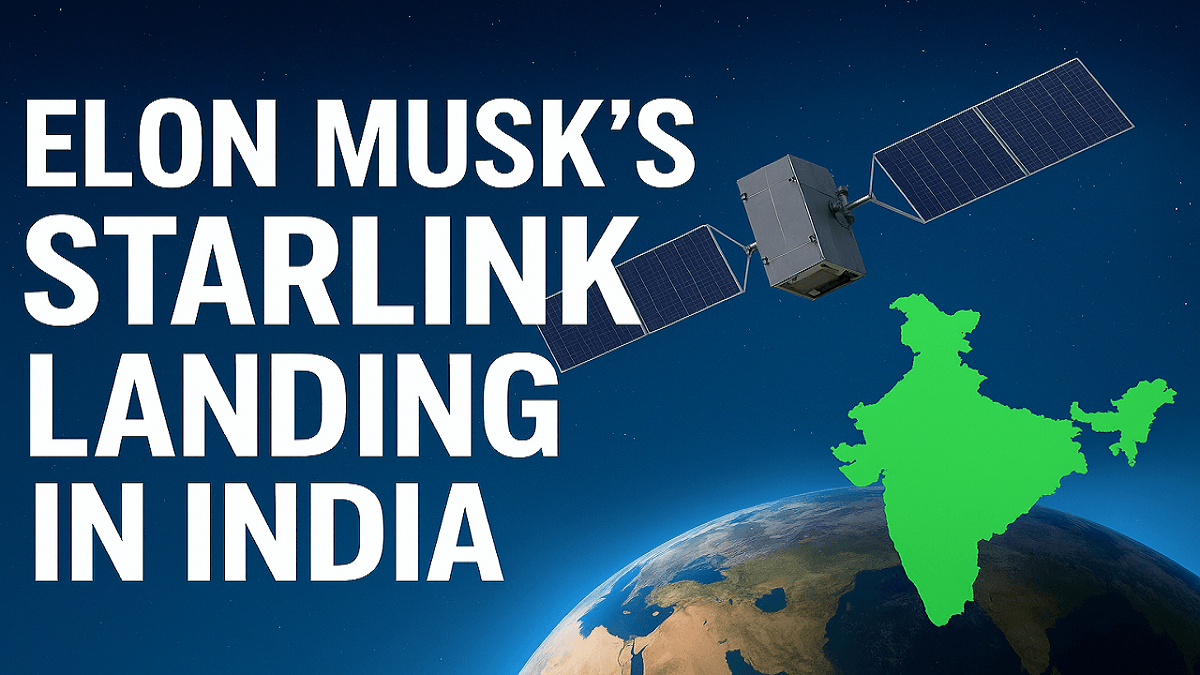
Starlink India Launch: Elon Musk’s in India
India has granted Starlink the key licenses needed to start operations. In June 2025 the telecom ministry issued Starlink a five-year Unified License (GMPCS). In July 2025 India’s space regulator (IN-SPACe) gave final approval, also valid five years. This makes Starlink the third company (after OneWeb and Jio-SES) to clear regulatory hurdles. Under the approval, Starlink can operate its Gen1 LEO constellation across Indian territory using Ka- and Ku‑band spectrum. However, strict security conditions apply: all user data and traffic must stay inside India, and Starlink must build domestic gateway earth stations (no traffic can be mirrored or decrypted outside India). Officials note the initial system capacity is limited, roughly two million connections, and service speeds up to ~200 Mbps.
Launch Timeline : Starlink India launch
With approvals in place, Starlink is aiming for service launch in about a year. Officials say operations could begin late 2025 or early 2026. India Today reports that “if all goes as planned,” Starlink may be offering service by end-2025/early-2026. A DoT source told NDTV the company expects to start service “within 12 months” of licensing. Reuters notes that Starlink still must secure the allotted spectrum, install gateways and user equipment, and undergo extensive testing – a “rigorous process” taking at least a couple of months before customer sales can begin.
-
Next steps: After securing licenses, Starlink will acquire administratively assigned spectrum (no auction, per the government’s decision) and construct ground infrastructure (gateways and earth stations) in India. Trial spectrum will likely be allotted first for compliance testing. Only once security rules are fully met will Starlink be allowed to sell services to users.
Pricing and Plans (Expected) : When Starlink India launch
No official Indian pricing has been announced. However, analysts project roughly similar costs as current global rates. India Today and NDTV cite industry estimates of a one-time hardware fee around ₹30,000–₹33,000 for the Starlink dish/router kit, and unlimited monthly plans in the range of about ₹3,000–₹4,200. These estimates align with neighboring Bhutan and Bangladesh, where Starlink “Residential Lite” plans run ~₹3,000 and standard ~₹4,000–4,200. (By contrast, incumbent fiber/broadband hardware costs in India are often much lower, and providers commonly bundle services with TV/OTT subscriptions.) Notably, India’s telecom regulator (TRAI) has proposed an administrative fee of 4% of revenue (plus a ₹500/year levy on each urban satcom user) for satellite broadband providers. This implies Starlink’s plans could be priced higher than typical mobile data (currently only ~₹8–10 per GB
 Availability and Coverage
Starlink’s service is expected to cover all of India’s territory once launched. IN-SPACe’s approval explicitly allows Starlink to operate its Gen1 LEO constellation “above India,” meaning the entire country can get coverage. The satellites are authorized to use a mix of Ka- and Ku-band frequencies for uplink and downlink over India. Globally Starlink already serves 100+ countries, and in Asia only Bhutan and Bangladesh have active service today. Once India comes online, virtually every village and remote region could receive signal (anywhere with a clear view of the sky). Preliminary reports suggest Indian service speeds may range from roughly 25 to 220 Mbps (depending on location and load) with total capacity of ~600–700 Gbps across India. In short, Starlink aims to deliver high-speed broadband even to India’s mountains, deserts and islands, complementing (not replacing) existing networks
Partnerships and Infrastructure Rollout
SpaceX has teamed up with India’s major carriers to help deploy Starlink:
-
Airtel partnership: In March 2025 Bharti Airtel announced an agreement with SpaceX. Under this deal, Airtel will explore selling Starlink user terminals through its retail stores and offering Starlink services to its business customers. They plan joint efforts to connect remote communities, schools and health centers using satellite links. The partnership also envisions leveraging Airtel’s network infrastructure (towers, fiber, backhaul) to support Starlink connectivity.
-
Jio Platforms partnership: Shortly afterward Reliance Jio announced a similar tie-up. Jio will distribute Starlink hardware via its outlets and online channels and establish customer support for installations. The goal is to bring “reliable broadband access nationwide,” including the most underserved, remote regions. Starlink’s service will complement JioFiber and JioAirFiber by reaching areas conventional networks cannot.
These private alliances are subject to SpaceX obtaining all licenses. Meanwhile, Starlink itself is preparing the physical rollout: after obtaining its licenses, the company must build ground gateways (per DoT security rules) and import user equipment. Government sources say Starlink will approach DoT for permission to import its antenna kits. In sum, international partners will supply the technology and distribution channels, while SpaceX and Indian agencies coordinate the infrastructure (satellite links, gateways, spectrum) needed for service launch.
Impact on Rural and Remote Connectivity : Starlink India launch
Starlink is widely seen as a potential game-changer for India’s digital divide. Its satellite-based delivery can reach pockets of the country that traditional networks miss. In particular, satellite broadband could finally connect many hilltop villages, tribal hamlets, Himalayan outposts and island communities where fibre and cell signals are absen. By providing a new path for Internet access, Starlink could enable e-learning, telemedicine, e-governance and rural business in these areas. For example, Airtel notes the partnership aims to bring connectivity to “even the most rural parts of India” (villages, schools, clinics), and Jio emphasizes serving “India’s most remote and underserved regions”. Analysts highlight that affordable high-speed broadband in such areas can have “far-reaching” benefits for education, health and commerce.
At the same time, regulators believe Starlink will coexist with (not displace) terrestrial players. The telecom minister has publicly downplayed any threat to providers like BSNL or 5G operators, noting Starlink’s focus on rural market segments and its limited subscriber base. In practice, Starlink is expected to complement India’s existing connectivity push (e.g. BharatNet, 5G rollout) by filling last-mile gaps rather than competing head-on in cities.
Potential Benefits and Challenges
Benefits: Starlink’s technology offers low-latency, high-speed Internet comparable to fibre in many cases. It can be deployed rapidly without ground labor. Satellite coverage is immune to many terrestrial disasters (floods, terrain blocks) and can boost border-area communications and national security connectivity. Government hopes that encouraging private satellite services like Starlink will spur innovation and help meet India’s target of universal broadband. Industry studies forecast that satellite broadband could serve millions of Indian households by 2030, adding new income and jobs in rural areas.
Challenges: There are significant hurdles in the Indian context. The cost of service is a major concern: the hardware kit (dish and router) is likely to cost on the order of ₹20,000–₹33,000 and monthly plans around ₹3,000–4,000. This is far more than typical urban fiber or mobile plans (Indian 4G costs only ~₹8–10/GB). Affordability for remote users may require subsidies or financing. Starlink’s capacity limits also pose a constraint: as noted, only ~2 million users can be served initially, limiting its reach in the short term.
Operationally, satellite service in India faces technical issues: signal can be degraded by heavy rain or difficult terrain, and each user needs a clear southern sky view for the dish. Logistics of installing and servicing hardware in remote regions will be challenging. Starlink must also navigate Indian regulations: strict data localization, security compliance and spectrum fees (TRAI’s 4% AGR proposal) add cost and complexity.
Finally, competition is intensifying. Reliance Jio’s fixed-wireless AirFiber and Bharti-Airtel’s planned OneWeb broadband will vie for the same rural market. Amazon’s Kuiper and local satellite operators might also enter after approvals. In this environment, Starlink will have to prove its value against lower-cost alternatives. The government’s focus on Atmanirbhar Bharat (self-reliance) means there will be pressure to encourage local manufacturing and ensure these services bolster India’s telecom ecosystem.
Sources: Information compiled from recent government statements, SpaceX/Airtel/Jio announcements, and reporting by major outlets (Reuters, India Today, Business Today, Times of India, NDTV, RCR Wireless, etc.)
Elon Musk’s Starlink Landing in India – Full Guide to Launch, Pricing & Impact
15 Highlight Keypoint Short Here: Elon Musk’s Starlink Landing in India
1. Starlink India Launch – A New Era for Internet Access
Starlink’s entry into India marks a turning point in how millions of people will access the internet. With SpaceX’s low-earth orbit satellites, India is set to experience faster and more reliable connectivity, even in remote areas.
2. Starlink India Pricing & Subscription Plans
While official pricing is yet to be confirmed, global Starlink packages suggest India could see monthly plans between ₹1,500–₹2,500. Installation kits may cost extra but will include a satellite dish and Wi-Fi router.
3. Starlink Availability & Coverage in India
Starlink’s coverage will gradually expand across India, beginning with rural and underserved regions. Its constellation of satellites will ensure pan-India availability, from metro cities to villages in the Himalayas.
4. Starlink vs Jio, Airtel & BSNL – The Competition
Unlike fiber-based ISPs such as JioFiber or Airtel Xstream, Starlink doesn’t rely on ground infrastructure. This gives it an edge in hard-to-reach areas, though traditional ISPs may still hold pricing advantages in urban centers.
5. Starlink’s Impact on Rural India
Over 600 million Indians still lack stable internet. Starlink promises to bridge this digital divide, enabling rural communities to access e-learning, e-commerce, telemedicine, and government services.
6. Starlink Technology – SpaceX’s Satellite Innovation
Starlink operates through thousands of low-Earth orbit satellites, ensuring low latency and high bandwidth. This innovative system will provide a new backbone for India’s digital economy.
7. Starlink Internet Speed in India
Globally, Starlink users enjoy speeds ranging from 50 Mbps to 250 Mbps, with latency as low as 20 ms. India can expect similar performance, making it suitable for streaming, gaming, and video conferencing.
8. Starlink for Businesses in India
Enterprises in logistics, IT, and remote operations will benefit from reliable satellite internet. Starlink offers businesses uninterrupted access, especially in industries working outside urban areas.
9. Starlink for Education & Students
For students in rural India, Starlink could be a game-changer. Online classes, digital libraries, and skill training will become accessible, bridging the educational gap between cities and villages.
10. Starlink for Healthcare & Telemedicine
Rural hospitals and clinics can leverage Starlink for telemedicine, online consultations, and real-time access to medical databases. This could significantly improve healthcare delivery in underserved regions.
11. Starlink & Tourism – Internet for Travelers
From the Himalayas to the Thar Desert, Starlink ensures travelers and digital nomads remain connected. Adventure tourism and remote work will flourish with satellite-powered internet.
12. Starlink in Smart Cities
Starlink’s role in smart cities includes powering IoT devices, surveillance systems, and real-time data exchange, making India’s digital infrastructure more resilient and futuristic.
13. Starlink for Farmers & Agriculture
With access to weather forecasts, crop monitoring apps, and digital marketplaces, Indian farmers will benefit from Starlink’s connectivity, leading to improved agricultural productivity.
14. Elon Musk’s Starlink Vision for India
Elon Musk envisions Starlink as a global internet provider, and India is a key market. This aligns with India’s Digital India initiative, helping accelerate connectivity nationwide.
15. The Future of Starlink in India
Starlink’s success in India depends on regulatory approvals, pricing strategies, and adoption rates. If executed well, it could revolutionize the country’s digital landscape.
Conclusion
Elon Musk’s Starlink landing in India is more than just a new internet service—it’s a step toward digital equality. From rural villages to smart cities, its impact will be felt across industries, education, healthcare, and beyond.